
Global

Copyright@ Australian Catholic University 1998-2026 | ABN 15 050 192 660 CRICOS registered provider: 00004G | PRV12008
Copyright@ Australian Catholic University 1998-2026 | ABN 15 050 192 660 CRICOS registered provider: 00004G | PRV12008

A little more than a decade ago, a software engineer named Joey McCollum sat in a church in Virginia and decided he wanted to learn ancient Greek. Not the classical dialect of Socrates and Plato, but the more vernacular Greek of the New Testament. His pastor was keen to teach his congregants how to read it, and Joey, who spent his working week writing code, was interested.
Once he learned the language, he immediately began putting it to use, poring over the New Testament at every opportunity.
“That was the first exposure I had to New Testament Greek,” he recalls, “but also the apparatus you sometimes find at the bottom of Greek New Testaments telling you which manuscripts have different texts and readings than the one you see printed, and that got me very curious.”
What followed was a decade-long detour into New Testament textual criticism.
Joey’s undergraduate degree had been in mathematics and creative writing – not an obvious foundation for biblical studies. Yet once his interest in textual criticism was sparked, he began reading the scholarship, eventually doing independent research and writing academic papers of his own. He attended conferences, volunteered to transcribe ancient manuscripts, and experimented with the computational methods that would eventually become the engine of his PhD.
He did all of this while holding down a job in software engineering, with no master’s degree and no academic credentials in biblical studies or theology.
By the time that he arrived at ACU’s Melbourne Campus in 2022 to begin his doctorate, he had a list of papers published in peer-reviewed journals (see here, here and here), and had built open-source software that other scholars were using to better understand the text of the New Testament.
His PhD is now complete. The examiners’ verdicts suggest that Dr Joey McCollum’s unconventional path led somewhere quite significant.
One examiner pronounced that he “deserves full credit for initiating what has the potential to be a fruitful new methodology for New Testament criticism”. Another called his chapter on the transmission history of Ephesians “a true tour de force”, noting that the thesis “far exceeds what could reasonably be expected in a three-year PhD”. His degree was awarded summa cum laude – with highest distinction.
“I was very pleased with the result, of course,” says Dr McCollum via video call from his home in the United States. “Pleased, but also very relieved.”
To understand what Joey McCollum has done, it helps to understand the problem he set out to solve.
Textual criticism – the discipline at the centre of his research – is, in his words: “The science of reconstructing the history of how a written work was transmitted, basically from the point it was published to the point in the present where we have some, but not all, copies of it.”
For ancient works like the New Testament, which survives in thousands of manuscripts but no originals, this is important work – precisely because the manuscripts do not all agree with each other.
Over centuries of hand-copying, scribes introduced many small changes – some accidental, some deliberate. Reconstructing what the original author actually wrote means navigating a vast and tangled web of copies, corrections and cross-contaminations.

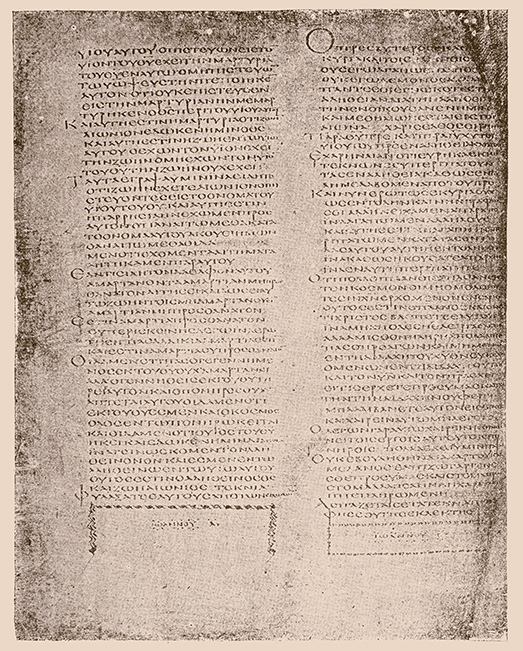
An image of Codex Sinaiticus, one of the earliest surviving Christian Bible manuscripts; and (main image, above) an image of Codex Alexandrinus, a 5th century manuscript.
“Textual criticism is especially valuable in this case,” Dr McCollum says, “because if you want to have an authoritative text that people can say, ‘This is most likely what the author intended’, you want to be able to reconstruct that as accurately as possible.”
For much of the 20th century, scholars tackled this problem through a method called eclecticism: going case by case through disputed passages and making judgment calls on which reading seemed most likely to be original. It was rigorous, slow work. But crucially, it left the broader history of how the text has travelled through time largely uncharted.
Dr McCollum’s research takes a different approach, with an aim to reconstruct not just the original wording but the transmission history itself: how changes in the text correspond to historical events that affected the church in different parts of the world.
The tool he reached for in this task comes not from biblical scholarship, but from evolutionary biology.
Bayesian phylogenetics is the computational method biologists use to reconstruct evolutionary relationships between species, using genetic data to build a scientific family tree.
The logic is that if you know how mutations accumulate over time, you can work backwards from what exists today and infer what might have existed in the past and how everything is connected.
The analogy to manuscript transmission is surprisingly tight, Dr McCollum says. As he explains in his research, “species are to evolutionary biology as manuscripts are to textual criticism”.
“So similar are the techniques and difficulties in DNA evolution and literary text evolution,” the evolutionary biologist Richard Dawkins once observed, “each can be used to illustrate the other.”
Dr McCollum’s thesis demonstrates just how true that is, forming what he labels “an unexpected alliance between biblical exegesis [the critical examination and interpretation of bible passages] and evolutionary biology”.

Dr Joey McCollum presenting his research at ACU's Rome Campus.
But the method he has developed goes further than previous attempts to apply phylogenetics to texts. The crucial innovation is Bayesian – that is, probabilistic.
Rather than producing one family tree and declaring it correct, his approach generates a distribution of possible trees, each assigned a probability based on how well it accounts for the available evidence and fits with what is already known about the transmission process.
One of the main advantages of this approach, Dr McCollum says, is that it allows you to quantify how certain or uncertain you are about the results you’re getting.
“One thing I have in my critical text of Ephesians that previous editions didn’t have is this calculation of how probable it is that this variant reading printed in the text is original, according to the model,” he says. “And in that way, in cases where that number isn’t as high, people can see, ‘Oh, there’s still an open question about this point of textual variation here’.”
The approach builds on a foundation laid by Dr McCollum’s primary supervisor at ACU, Associate Professor Stephen Carlson, whose own doctoral research on Galatians combined exegesis with computational methods for building family trees of manuscripts. His associate supervisor, Dr Robert Turnbull, whose doctoral research applied Bayesian methods to the Gospels, introduced him to the probabilistic framework at the heart of the approach.
It’s important to point out here that the computer is not doing the work alone. Human judgment about the internal character of readings – what the author was likely to have written, how scribes were likely to have changed things, what theological pressures might have been at work – is all factored in before the algorithm runs. The machine then tests those judgments against the full weight of the evidence.
“I anticipate people thinking that this is a black box and you just have the computer do it all for you, and that’s not how it works at all,” Dr McCollum says. “The computer will do what it can with the information it has, but human judgment is very valuable information to provide as input in that process.”
The implications of the methodology extend well beyond Ephesians or even the New Testament.
During the final year of his candidature, Dr McCollum was approached by a PhD student from the University of Antwerp who had read one of his papers. She was working on a medieval Dutch poem and wanted to know whether his approach could be applied to her tradition.
The results were so promising that the two presented a paper together at a conference in Belgium. Dr McCollum is now planning a workshop in Europe to showcase what Bayesian phylogenetics can do for other textual traditions.
He is also preparing to take up a postdoctoral position at KU Leuven, where he’ll work with a team specialising in the ancient translations of the New Testament and how they influenced one another.

Joey McCollum in Rome with two fellow students from his cohort, Rebecca Lloyd-Hagemann (centre) and Emily Fero-Kovassy.
The long-term ambition is a modest but meaningful one: that scholars working on handwritten traditions – from medieval poetry to early Christian scripture – will begin to see what these scientific tools have to offer them.
“So much work relevant to the reconstruction of textual histories has already been done in evolutionary biology,” Dr McCollum said in 2024, when he took top prize in ACU’s Three Minute Thesis competition. “The textual criticism and digital humanities communities should be aware of how valuable it is to our work.”
There’s another dimension to this story that Dr McCollum is more than happy to talk about. Though much of his working life has been in STEM, he always found more joy in the humanities.
“When I was able to start applying those technical skills to the humanities and to New Testament textual criticism in particular, it really got me excited,” he says.
This journey has certainly changed him – not just intellectually, but in the way he relates to the texts he has spent years studying. Thanks to an opportunity from his co-supervisor, Associate Professor Kylie Crabbe, he was able to teach New Testament Greek for two semesters, bringing his own path full circle to that first church class in Virginia.
But what effect has the research had on his faith?
“Oh, it’s been great,” he says.
“Learning how to do biblical exegesis gave me this entirely new appreciation for the text, and for all these little details that I’d never noticed before, even though I’d read the book so many times.”
He pauses, then smiles and continues.
“There were some places in my thesis, and you can certainly judge this for yourself, but there were places where my discussion of the author’s argument in the passage led to insights that I think could even be, like, preachable ideas. And I thought that was just a joy.”
It’s perhaps an unexpected thing to hear about a PhD built on computational biology, probability theory, and more than a thousand years of handwritten manuscripts. But for Dr Joey McCollum, it sounds exactly right.
Dr Joey McCollum is currently revising and expanding his thesis for publication as a monograph, and it’s therefore under embargo. If you’d like to read it in its current form for personal use, email james.joey.mccollum@gmail.com
Keen to explore Higher Degree Research at ACU’s Institute for Religion and Critical Inquiry? Explore the options.
Copyright@ Australian Catholic University 1998-2026 | ABN 15 050 192 660 CRICOS registered provider: 00004G | PRV12008